
Building a Resilient Athlete: Evidence-Based Strategies to Reduce ACL Injury Risk in Young Athletes
ACL Injury Prevention in Youth Athletes: Building Movement Skills for Performance and Safety
Why we should care
An ACL tear is a devastating injury, that often keep athletes out of competition for close to a year. ACL tears don't just happen to professionals. They happen to 14-year-olds playing recreational soccer, to high school basketball players, and even to kids just playing around for fun. An ACL tear can mean significant time off the field, surgery, and a significantly higher risk of developing knee arthritis later in life.
We often assume the ACL tears happen primarily when an athlete is bumped, pushed, or tripped, however, up to 70% of ACL injuries in youth athletes aren't from collisions but rather a non-contact injury. A bad landing. A knee caving inward during a cut. These are patterns that can be addressed with young athletes before they ever cause harm. Girls face a particularly outsized risk, somewhere between two and six times higher than boys for non-contact ACL tears, which makes early intervention especially important for female athletes.
Although there is nothing anyone can do to completely remove the risk of injury in sport, we can significantly reduce the likelihood of ACL injuries.
If you want your athlete or team to implement the below strategies, just reach out and we are happy to help!
Understanding the risk
Movement mechanics
A lot of young players simply haven't developed the body control needed to protect their knees under the increasing demands of sports. Poor control of landings, stiff-legged jumps, and knees that cave excessively inward during direction changes all place excess stress on the ACL. Underdeveloped hips and a weak core mean the pelvis struggles stabilize the leg properly, which puts more force on the knee.
Specialization and fatigue
Playing one sport year-round has become increasingly common, and increasingly problematic. Repetitive stress on the same joints, without the varied movement that comes from playing multiple sports, leads to overuse and potential muscular imbalance. Kids who play multiple sports tend to develop more well-rounded athleticism, and that variety appears to reduce injury risk.
Fatigue matters here too, and it often gets overlooked. Biomechanical research shows that as athletes tire, their technique breaks down, knees drift inward, trunk control drops, landing mechanics deteriorate. Prevention training needs to be woven into regular practice, not treated as an occasional extra.
What actually works
Research on ACL prevention programs is fairly clear about what the core elements should be: lower body and core strengthening, plyometric training, consistent coaching feedback, adequate training volume, and balance work. Stretching can be included, but it's of relatively low importance, as there is not any strong evidence that flexibility work alone reduces ACL injury rates. Sessions don't need to be long — 10 to 15 minutes, two or three times a week, adds up to 30 to 60 minutes of meaningful training. Starting in pre-season and continuing through the season matters; programs that stop after pre-season lose much of their protective effect.
Strength
This is where the real protection comes from. Strong hip abductors and external rotators help keep the knee from collapsing inward. Strong hamstrings counteract the quad's forward pull on the shinbone. Core strength keeps the pelvis stable so the knee doesn't have to compensate. A strong quad helps absorb the force of cutting and landing. Research consistently shows that neuromuscular and strength training, started young, offers the greatest reduction in ACL injuries.
These exercises do not need to be complicated: hamstring curls (ball or Nordic), squats, lunges, step downs, deadlifts, glute bridges, and core work like planks.
Plyometrics and landing mechanics
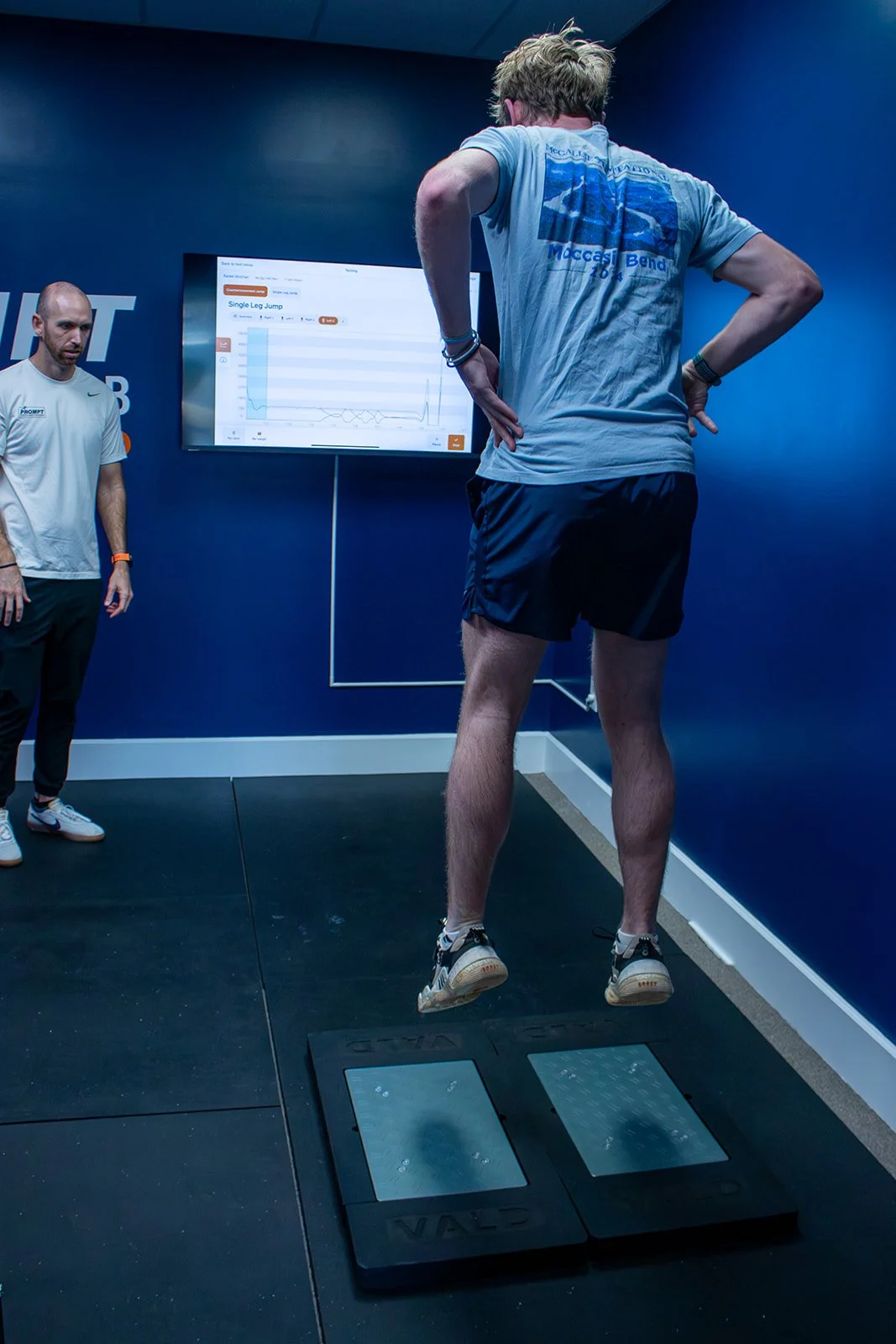
Force plate assessments for landing mechanics, power, and explosivity
Jump training teaches athletes to generate force and absorb it. The inability ability to control landing force and cutting force are two things that go wrong in most ACL injuries. Tuck jumps, single leg jumps, broad jumps, drop jumps, small altitude drops, skater hops, lunge hops are all drills that give athletes repeated practice landing under control, with knees tracking over the toes, and force distributed through the ankles, knees, and hips. Studies have found that well-designed neuromuscular training programs combining plyometrics, agility, and strength can reduce non-contact ACL injuries in female athletes by up to 67%.
Technique matters here more than volume. Coaches should be watching and providing feedback, because a poorly executed jump drills can reinforce the exact patterns you're trying to correct.
Balance and proprioception
Proprioception, or the ability to control one’s body in space is another key component of prevention. Single-leg stance work, multidirectional reaches, passing a ball while standing on one leg all build the body awareness athletes need to control themselves in unpredictable situations. That said, balance training on its own doesn't meaningfully reduce ACL injuries, and there's no real evidence that unstable surfaces like wobble boards or BOSU balls add much beyond what you'd get from solid single-leg training on the ground. Skip the gimmicks, focus on single-leg control and landing mechanics on stable surfaces.
Dynamic warm-ups
A good warm-up prepares the body to move well. Programs like FIFA 11+ Kids use jogging, lunges, high knees, and heel kicks to prime muscles and the nervous system before practice. Dynamic warm-ups are more useful than static stretching before activity. Athletes with notable mobility restrictions can address those specifically, but for most players, a movement-based warm-up followed by strength and plyometric work is the right approach.
Starting early
Introducing this kind of training in late childhood — before the teenage years when ACL injury rates spike — gives athletes more time to internalize proper movement. The FIFA 11+ Kids program is designed for children aged 10 to 12 and can be integrated into physical education. Good movement habits formed early become automatic, which is exactly what you want when an athlete is fatigued and reacting in real-time.
Playing multiple sports during these years helps too. Diverse motor patterns, adequate rest, and delayed specialization are all part of keeping young athletes healthy long-term.
The bigger picture
Teaching young athletes to move well isn't about fear of injury. It's about giving them a body that works better, faster cuts, stronger landings, and more confidence in their movement. The programs that do this well are inexpensive, require almost no equipment, and pay dividends well beyond a single sport season. Start early, prioritize strength and movement quality over flexibility gimmicks, and let kids play more than one sport. That combination goes a long way. Want help setting up a program that works? Reach out and we’ll be happy to help!
Sources:
Ardern CL, Webster KE, Taylor NF, Feller JA. Return to sport following anterior cruciate ligament reconstruction surgery. British Journal of Sports Medicine. 2011,45,596–606.
Bahr R, Krosshaug T. Understanding injury mechanisms. A key component of preventing injuries in sport. British Journal of Sports Medicine. 2005,39,324–329.
Emery CA, Roy TO, Whittaker JL, Nettel-Aguirre A, van Mechelen W. Neuromuscular training injury prevention strategies in youth sport. A systematic review and meta-analysis. British Journal of Sports Medicine. 2015,49,865–870.
Faude O, Rößler R, Junge A. Football injury prevention programmes for children and adolescents. Systematic review and meta-analysis. Sports Medicine. 2013,43,659–674.
Grindem H, Snyder-Mackler L, Moksnes H, Engebretsen L, Risberg MA. Simple decision rules can reduce reinjury risk by delaying return to sport after ACL reconstruction. British Journal of Sports Medicine. 2016,50,804–808.
Herman K, Barton C, Malliaras P, Morrissey D. The effectiveness of neuromuscular warm-up strategies to prevent lower limb injuries in sports. A systematic review and meta-analysis. Sports Medicine. 2012,42,773–792.
Hewett TE, Myer GD, Ford KR. Anterior cruciate ligament injuries in female athletes. Part 1. Mechanisms and risk factors. American Journal of Sports Medicine. 2006,34,299–311.
Lauersen JB, Bertelsen DM, Andersen LB. The effectiveness of exercise interventions to prevent sports injuries. A systematic review and meta-analysis of randomized controlled trials. British Journal of Sports Medicine. 2014,48,871–877.
Myer GD, Faigenbaum AD, Ford KR, Best TM, Bergeron MF, Hewett TE. When to initiate integrative neuromuscular training to reduce sports related injuries in youth. Current Sports Medicine Reports. 2011,10,155–166.
Sugimoto D, Myer GD, Bush HM, Klugman MF, Medina McKeon JM, Hewett TE. Compliance with neuromuscular training and injury prevention in youth athletes. A systematic review and meta-analysis. British Journal of Sports Medicine. 2014,48,885–891.
Webster KE, Hewett TE. What is the evidence for and validity of return to sport testing after ACL reconstruction surgery. A systematic review and meta-analysis. Sports Medicine. 2019,49,917–929.
Jordan MJ, Morris N, Lane M, Barnert J, MacGregor K, Heard M, Robinson S, Herzog W. Monitoring the return to sport transition after ACL injury. An alpine ski racing case study. Frontiers in Sports and Active Living. 2020. Monitoring the Return to Sport …
Kotsifaki A, Van Rossom S, Whiteley R, Korakakis V, Bahr R, Sideris V, Jonkers I. Single leg vertical jump performance identifies knee function deficits at return to sport after ACL reconstruction in male athletes. British Journal of Sports Medicine. 2022.